Disclosure: This site may contain affiliate links. If you purchase through these links, we may earn a commission at no additional cost to you.
The Difference Between a Hunter and a Sportsman
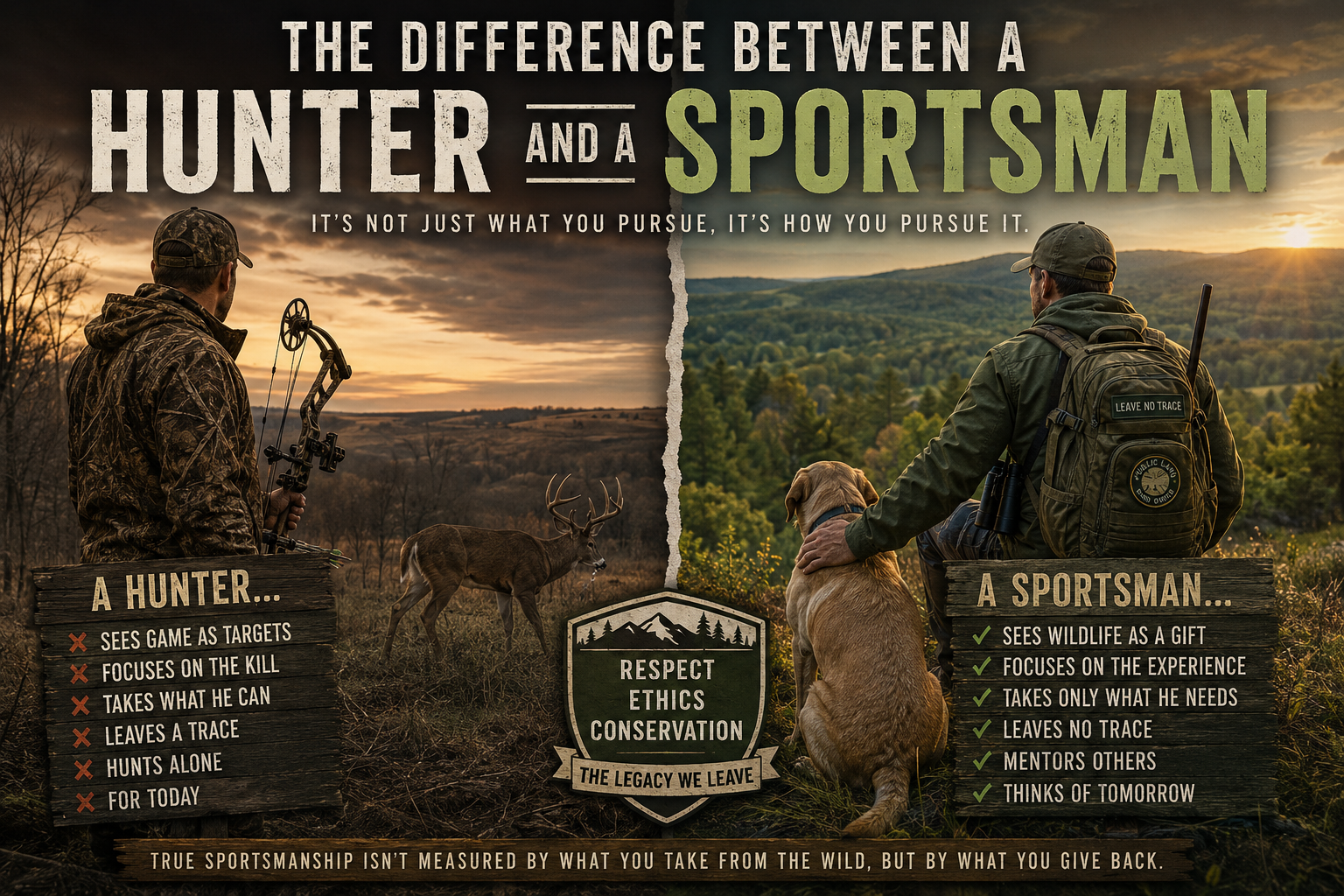
To many people, hunter and sportsman are interchangeable words. Both describe someone who goes into the woods or on the water in pursuit of wild game. Yet within the outdoor community the terms carry distinct meanings that reveal deeper differences in identity, values and purpose. Understanding these distinctions is essential for anyone who wants to represent the outdoors with integrity and inspire others to follow.
This article outlines the core differences between a hunter and a sportsman and explains why those differences matter. It is not meant to demean those who call themselves hunters, many hunters are sportsmen. It is a guide to the mindset and habits that elevate an outdoorsman from merely pursuing game to embodying a way of life rooted in respect, ethics, stewardship and personal growth.
Article Outline
1. Definition and Identity
2. Attitude Toward Wildlife
3. Approach to the Environment
4. Community and Mentorship
5. Personal Development
6. Use of the Harvest
7. Public Perception
8. Why the Difference Matters
9. Becoming a Sportsman
10. Conclusion and Call to Action
1. Definition and Identity
Hunter: At its simplest, a hunter is someone who pursues, captures or kills wild animals. The term does not inherently describe how or why the hunt is conducted. Hunters range from subsistence providers to trophy seekers to those who harvest as a means of connecting to nature. Some hunters follow the highest ethical standards; others do not.
Sportsman: A sportsman (or sportswoman) is a hunter or angler who pursues wildlife with a strong code of ethics, deep respect for the quarry and a commitment to conservation. A sportsman values fair chase, uses his or her skills responsibly and invests in the health of ecosystems and communities. The term evokes honor and stewardship.
Identity Differences:
· A hunter identifies with the act of hunting. A sportsman identifies with a lifestyle that extends beyond the act.
· For a hunter, success may be measured by the size or number of animals taken. For a sportsman, success is measured by the quality of the experience, the integrity of the pursuit and the legacy left behind.
2. Attitude Toward Wildlife
One of the clearest distinctions lies in the way the hunter or sportsman relates to the animals being pursued.
Hunter:
· May see wildlife primarily as targets or trophies.
· Focuses on the outcome filling a tag or collecting antlers.
· Might take any legal shot that ensures a kill, sometimes prioritizing success over challenge.
· May not differentiate between species beyond legal restrictions.
Sportsman:
· Sees wildlife as fellow participants in the encounter. There is reverence for the animal’s life.
· Values challenge and the ethics of fair chase over guaranteed success.
· Passes up low‑percentage or unethical shots even if legal. Chooses to harvest animals selectively based on age structure or herd health.
· Learns about species’ biology, breeding cycles, migration and habitat needs. The relationship extends beyond the moment of harvest.
In essence, a sportsman’s attitude is rooted in respect. The animal is not a “target” to be conquered but a part of a larger ecosystem that deserves thoughtful treatment.
3. Approach to the Environment
Hunter:
· May see land and water primarily as hunting or fishing grounds.
· Might not think about the broader impact of foot traffic, motorized vehicles or gear on fragile habitats.
· May leave behind litter or waste if unaware of Leave No Trace principles.
Sportsman:
· Views the environment as a shared resource to be protected. Recognizes that healthy habitats sustain wildlife and recreation.
· Practices Leave No Trace: packs out all trash, avoids damaging vegetation, camps in durable places and keeps campfires minimal.
· Participates in habitat restoration projects, such as planting trees, building fish shelters and removing invasive species.
· Supports policies that conserve wetlands, prairies, forests and watersheds.
A sportsman understands that his actions even when pursuing personal enjoyment affect the health of wildlife populations and the access future generations will have to those lands and waters.
4. Community and Mentorship
Hunter:
· May hunt alone or with a small group of like‑minded friends.
· Might not feel compelled to recruit new participants or teach newcomers.
· Could be reluctant to share knowledge out of fear of competition.
Sportsman:
· Actively mentors newcomers, especially youth and underrepresented groups. Recognizes that the future of hunting and fishing depends on recruiting diverse participants.
· Shares skills freely. Teaches others how to shoot safely, cast accurately, track ethically and butcher respectfully.
· Builds inclusive communities. Joins conservation organizations, attends meetings and collaborates with peers on stewardship projects.
· Celebrates others’ successes without jealousy. A sportsman finds joy in another person’s first deer or first fish as much as his own.
Community is a cornerstone of sportsmanship. Mentorship ensures that ethics and traditions persist; collaboration amplifies conservation outcomes.
5. Personal Development
Hunter:
· May hunt as a means to an end like food, trophies or recreation without deliberately linking the pursuit to personal growth.
· Skills are developed primarily to improve success rates.
Sportsman:
· Sees the outdoors as a classroom for character development. Patience, resilience, humility and mental toughness are as important as marksmanship and casting technique.
· Uses time afield to reflect, problem‑solve and cultivate gratitude. Confronts discomfort, delayed gratification and failure as opportunities for growth.
· Applies lessons from the field to everyday life, whether at work, in relationships or in community service.
Personal growth is not accidental. A sportsman deliberately seeks lessons from each outing, even when no animal is harvested or fish is landed.
6. Use of the Harvest
Hunter:
· Some hunters may practice “trophy” hunting, focusing on antlers or horns and discarding edible portions. Others may not maximize use of the game or fish they take.
· Food may not be the primary motivator.
Sportsman:
· Uses as much of the harvested animal as possible. Processes meat carefully, shares with family, friends or those in need, and preserves skins, feathers or antlers respectfully.
· Learns proper field dressing, meat care and cooking techniques. Takes pride in preparing meals from wild game and fish.
· Donates extra meat or fish to food banks where legal and encouraged.
A sportsman honors the life taken by minimizing waste. The harvest nourishes both body and soul.
7. Public Perception
Hunters often face negative stereotypes, sometimes fueled by irresponsible behavior documented in media. Conflating all hunters with unethical or careless actions harms the image of the broader outdoors community.
Sportsmen and sportswomen have an opportunity to reshape public perception:
· Transparency: They share the full story of their hunts, including preparation, conservation efforts, recovery and use of the animal. This counters the caricature of bloodlust.
· Ethical Imagery: They avoid posting disrespectful photos (e.g., animals in the back of a truck with tongues hanging out). They show respect even in digital spaces.
· Advocacy: They speak up for conservation, public land access and ethical behavior in online communities and public forums.
· Representation: By mentoring diverse participants, they broaden the image of who hunts and fishes, demonstrating that it is not limited to a single demographic.
When the public sees hunters who are generous, respectful, environmentally conscious and engaged in community service, negative stereotypes are challenged.
8. Why the Difference Matters
The distinction between a hunter and a sportsman might seem semantic, but it carries significant implications:
· Sustainability: Sportsmen invest in conservation and fair chase, helping ensure that wildlife populations remain healthy for future harvests. Hunters who ignore these principles risk damaging ecosystems and reducing game abundance.
· Legitimacy: Ethical sportsmen lend credibility to hunting and fishing in policy debates. Legislators and the public are more likely to support these activities when they see participants upholding high standards.
· Recruitment: A welcoming, values‑driven community draws newcomers. Without new participants, license sales decline, reducing funding for conservation.
· Personal Fulfillment: Sportsmen derive deeper satisfaction from their pursuits. Experiences become meaningful rituals rather than short‑lived trophies.
Distinguishing and aspiring to sportsmanship safeguards the future of hunting and fishing and enriches the experience for those who participate.
9. Becoming a Sportsman
If you hunt or fish and want to embody sportsmanship, here are steps to bridge the gap:
1. Reflect on Your Why: Examine why you hunt or fish. Clarify whether you are motivated by food, tradition, challenge or something else. Consider how respect, stewardship and community fit into your motivations.
2. Learn Conservation History: Study the North American Model of Wildlife Conservation. Understand how regulated hunting and fishing rebuilt species such as whitetail deer, wild turkey and wood duck.
3. Commit to Fair Chase: Adopt a fair chase ethic that respects animals’ ability to elude hunters. Pass up shots that don’t meet your standard. Choose methods and technologies that emphasize skill.
4. Engage in Stewardship: Participate in habitat work. Contribute financially to conservation organizations. Advocate for sound wildlife policies.
5. Mentor Others: Take someone hunting or fishing for the first time. Share your skills and ethics. Encourage diversity among participants.
6. Embrace Humility: Acknowledge mistakes and learn from them. Seek feedback from more experienced sportsmen and women. Maintain a growth mindset.
7. Tell Better Stories: When sharing your experiences, emphasize the process, the lessons and the respect you showed. Avoid sensationalism. Educate your audience.
Transitioning from hunter to sportsman is not about perfection. It is about progression—choosing to align your actions with values that honor wildlife, land, community and yourself.
10. Conclusion and Call to Action
In the simplest terms, all sportsmen are hunters or anglers, but not all hunters or anglers are sportsmen. Hunter describes an activity; sportsman describes a way of living that elevates that activity into an expression of respect, stewardship, community and personal growth.
The difference matters because the future of hunting and fishing depends on public trust, ethical behavior, healthy ecosystems and strong communities. By embracing the identity of a sportsman, you become an ambassador for the outdoors and a guardian of its resources. You transform each outing into more than a pursuit; it becomes an opportunity to build character, foster connection and leave a positive legacy.
If you already embody these values, share them. If you are new to them, adopt one habit at a time. Your commitment will ripple through your family, your community and the landscapes you love.
Be more than a hunter. Be a sportsman. The difference is what will preserve the outdoors for generations to come.